Main | March 2008 »

February 2008 Archives

February 1, 2008

quick thoughts on different narrative mediums
theecstasyofgarry.gif

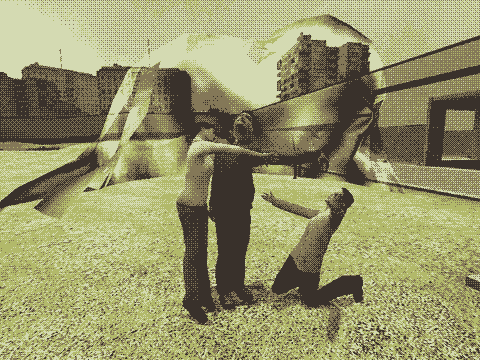
The difference between video games and older media such as books and movies is a very interesting place. It doesn't seem as clear cut as I would like to think it is. When i try and think of the narrative in the video games i have experienced it runs the gamut from standard linear narrative to very non linear or non-narrative plots. Tetris would be a good example of a game with no narrative, and I think that something like Dark Forces two, the star wars game is a great example of a game where your actions throughout the game effect the overall outcome. Movies seem to have had a hard time creating really strong linear narratives without the help of things like computers and the internet. And books seem to have gone back to that classic linear craze that we all know and love.
Non linear narrative is not exactly new, but it still may be an invention of the twentieth century. The first examples i can think of, which i am probably wrong about, are those old choose your own adventure stories. You know the ones, where you would get to a certain point in the book and choose, sometimes arbitrarily a new page to journey down. But as I write this I feel like the difference in the three is where they all take me.
There is some part of my brain that wants to think "why aren't games even more popular, when are books and movies going to slowly vanish into the vast halls of history?" but at the same time i find myself fighting what video games do and I think about that when I think about how i still like books, the old fashioned paper scrawled with ink linear narrative book. I think one of the thinks that is so appealing about books is the space they allow for your mind to go off into these deep holes in your brain, there is no image, there is no soundtrack. The reader can choose to imagine those things at there will. I try to think of how differently i imagine the scenes in a book from every other person reading the very same words. Sometimes I find that element of video games (and a lot of movies) leaving me a bit perturbed. But i don't feel like all hope is lost, in fact, i think that video games have a larger potential than what has been realized and they could cross those boundries to create the Ulysses of video games and the crime and punishment of first person shooters. I just kind of blasted these thoughts on the page though so forgive me if you have no idea what i am talking about.

Love,
Darren
February 20, 2008

everything_ptII_01.jpg

Here is a little gem

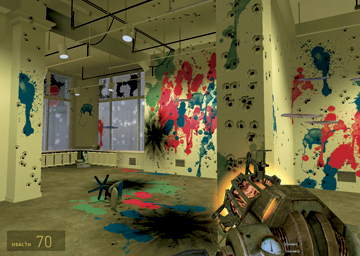
Okay, so this is a mod that takes the actual gallery space at the school of the art insitute of chicago and lets user go around with all sorts of destructive little tools to paint and destroy the gallery space, when you are physically in the gallery space. I just think this is absolutely genius. Reason one of why i like it is that it seems to start blurring the reality between the physical and the digital world. I feel that it touches on some really interesting points that are going on today, first being the idea that video games are this sort of all powerful influential device that has caused some pretty horrible real life problems (I am recalling things like Columbine and many other youth related tragedies). Maybe the heat has died down a little on video games (or i have stopped reading the parenting magazines that my mom used to leave around when i lived at home) but I think it is somethig to think about. What does the gallery have to fear having this completely vulnerable digital replica being destroyed by all the people who walk through the physical space. Should we fear the user at the gallery? Should we fear the kid at home who plays video games on a daily basis when said games have depictions of violence, sometimes very realistic might I add. I do't really know, but I tend to lean on the side of no, the kinds of people who bring the violemce and destruction of a video game into the real world are already fucked up and probably would have done it anyways. Reason 2 of why I find this piece intriguing which is actually kind of similar to reason one is that it seems to be commenting on the current trend of bringing tangible computing to everyone and everything. The ideas have really been flying lately to turn almost everythig we own into some sort of digitized device. I know so far that house lights, dishwashers, laundry machines, air conditioners, and probably a million other things that I never knew needed a wifi card are in some form of development. Where is that going to take us. I really think that this piece, actually, I am having a difficult time with this one, there is something in my head going around with key phrases such as blur, tangible, space, reality, future and they are just kind of floating there. ON TO REASON 3: it questions weather a computer game is art. This debate still seems to be going on and probably won't be answered for a while if ever. But what does happen when a computer terminal is brought into a gallery space? is that fact that, in this case, only one person at a time can actually experience the game an issue? If there is a learning curve (and i beleive that there are some people out there, my parents included, that might have a hard time getting used to that sort of interface) does that change the piece? I am not done with this reason either. Reason 4: the title says it all "Everything I Do is Art, But Nothing I Do Makes Any Difference, Part II Or: How I Learned to Stop Worrying and Love the Gallery"

Darren

February 27, 2008

five things I think about the game design sequence

A good game designer must set out to design a game that touches upon the players lives in some way. They must ask the "why?" question

The topic is an interesting tightrope to be on because you can end up relying to much the location of thd game and all those details and loose the message.

You must give yourself enough time, and ask yourself the proper, sometimes difficult questions, and emerse yourself in items that refelct the games goals and topic.

the design phase (I/O phase) is tricky because this is where it all really goes down. The input and out put must be cosidered, and the program structure must be extensively planned.

Programming seems to be pretty "simple" and straightforeward.

playtesting is an important step in figuring out how others willl react, because time will taint your objectivity.

About February 2008

This page contains all entries posted to Darren Evans in February 2008. They are listed from oldest to newest.

March 2008 is the next archive.

Many more can be found on the main index page or by looking through the archives.

Powered by
Movable Type 3.31