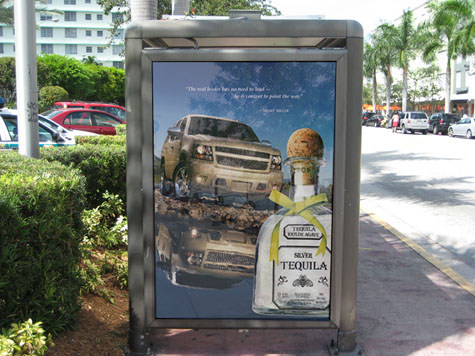
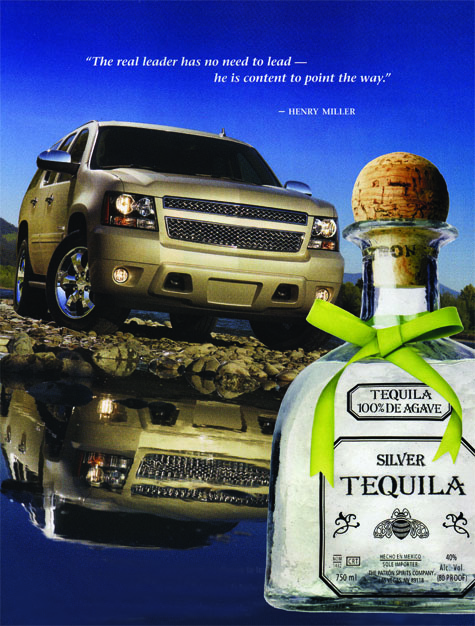
Car & Tequila poster 3
Détournement involves the usage of artistic elements already created for use in other work, using these elements in a new work that gains it's own meaning from the combination of the détourned members, while changing the original meaning of them.
According to Debord, each element used in détournement must loose it's original importance while conferring a new meaning to the ensemble through the organization with the other elements. New meanings from elements that were originally meant to convey some other meaning. In the article Debord says "At this point in the world's development, all forms of expression are losing their grip on reality and being reduced to self-parody." The original meaning is commented on by the détournement, while suggesting a broader interpretation for the images presented as a new ensemble. It is the unification with other elements which had their own original context that creates a new context with the combined ideas. The parts put together add up to a sum greater than the parts counted separately.
The extent to which this kind of détournement takes place in our society now is that it is not only unavoidable, but expected. Nobody is surprised to hear or see artistic elements from the past in new work. And it makes sense. It happens with technology, why not in the art world? Technology depends on the use of previous work in order to advance. Could this mean that art does the same? Debord says, "...the attempts to resuse the "detournable bloc" as material for other ensembles express the search for a vaster construction, a new genre of creation at a higher level." That statement makes me think of technological advancement, each higher level of technology being built on previous advancements creating new levels that are dependent upon the building blocks of the past.

I keep seeing these alcohol ads where the bottle is beautiful and perfectly lit, while if there is a person in the ad, they are slick, well dressed, perfectly sober and sharp, never drunk. It seems to me, that by drinking any kind of alcohol, I am not going to get any closer to that perfect business man, or the rugged and healthy outdoorsman, etc.. In fact, my experience with alcohol has been quite the opposite. I think after a few drinks I'm actually less likely to get that job I'm interviewing for, or cut that big business deal. And whether I'm navigating the open sea or hiking into the mountains in search of the perfect camping spot in the middle of nowhere, I'd rather not be uninhibited by the joys of drunkenness, because when you live your life on the edge, hard liquor is not exactly your friend (even though it's alot of fun).
I'd like to see some more realistic displays of drinking in these ads. Let's see some drunk people! People acting like idiots while all their friends are loving it. That sort of thing.
The last time I got fooled by one of those sophisticated liquor ads, I had a good time, but ended up broke and stumbling into a taxi cab I couldn't afford. That's the image that comes to mind when I think of those beautiful, perfectly lit bottles.
On page 139 John Berger says, "Publicity is, in essence, nostalgic. It has to sell the past to the future. It cannot itself supply the standards of its own claims. (etc...)"
I disagree with this. Publicity need not be nostalgic. It can, in fact, sell the future to the present. Especially in this technological age this kind of selling has become particularly relevant. The idea that the future is now, and that sort of perspective draws us in to continually wanting what is next- the next newest thing. This kind of advertising shows us a brighter future, where everything works and is perfect, and convinces us that what it is selling will bring that future to our current life. I thought of the example of the wildly successful iPod ads. These ads have shown us a simplified lifestyle which doesn't need nostalgic context. They have indeed supplied the standards of their own claims.
That example brings me to one of the many points Berger has made that I do agree with. On page 153 he says, "Publicity is essentially eventless. It extends just as far as nothing else is happening.... ....The act of acquiring has taken the place of all other actions, the sense of having has obliterated all other senses."
Those famous iPod ads fit perfectly into this description. All we see is the silhouette of the dancing person on the colorful background with the white earphone wires flailing around to the dancing motion. Nothing other than the iPod is important- there is no event, only the device. The only thing that matters to the viewer is the acquisition of the iPod. All senses other than those pertaining to the iPod have been obliterated. These brilliant ads have broken the image down to the simplest possible form, blinding us from everything else except what they are selling. The iPod becomes a part of the person, and the only thing in existence. We must have the iPod to be complete.