The final parts of my final (ANDY PLEASE LOOK AT THIS BEFORE MAKING THE FINAL GRADES)
Here I have my two finished copies of my final
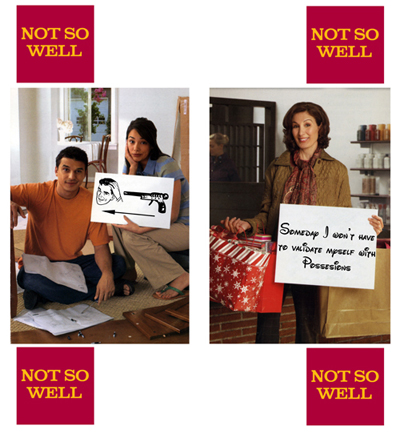
the presented piece

and the other option
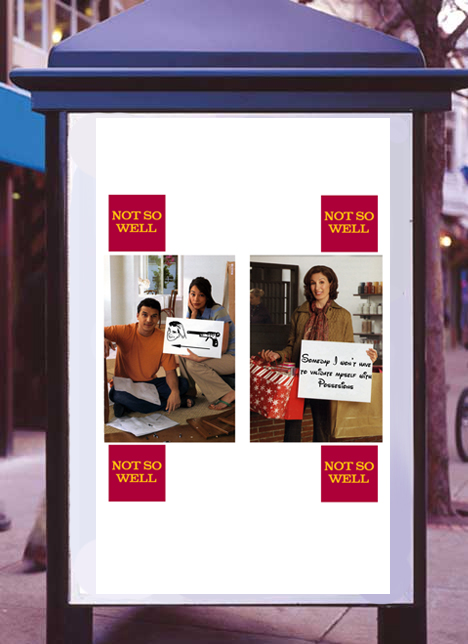
along with what it would look like in the Marina
Here I have my two finished copies of my final
the presented piece
and the other option
along with what it would look like in the Marina
After many tests and drafts....it is the general consensus that this should be the final poster
I hope you enjoy
and DEAR GOD I hope it loads...
Download file
It seems to me that the defination of detournment would be an art image or one of the mass media that one would change or alter either by changing the image or the environment its in. This would then change the intentions and messages of the piece.
It's about using art symbols and resources to create something different than they were intended for. (Was that it?) One of the main requirements include the ability to have this somewhat objective relationship to the image you will transform. This is a method that is mentioned as being the easiest to continue and reuse.
I somehow think back to Roy Lichtenstein's pop art comics and Andy Warhol.
As for my advertisement project, I'm thinking of transforming the current advertisements of Well Fargo that always focus on the future you can obtain through Wells Fargo. Most of these advertisements include the message "Someday...." and are then followed by a current longing.
For instance, "Someday, I will have a bigger bathroom" or "Someday we will have a guest room." Most of these goals are pretty material in wanting more house space or more things. Some focus on career goals such as "Someday I will trade in this coffee pot for scuba gear" with a waitress holding a pot of coffee at a diner.
My goal is to attack how intruding and obnoxious these ads are by replacing the want with such messages as "...I won't have to want" "we won't have to taunt you for your money" and "...we will continue materialism---wait a minute"
I can't decide how to do this or where to do this yet.
but here is an example of the image at hand

giving really isn't enough unless I'm rewarded more
plus, that children's activity book seems a little creepy
I am also thinking of working this image

only because I like the medication mixed with money
however, I can't decide what to do with this yet.
In first reading this article, with its focus on advertisements and images that we normally take for granted in our daily lives, I thought back to a cheesy Julia Roberts film 2003, "Mona Lisa Smile." I'm not perticularly fond of this film. However, I couldn't help but think back to one part of the film where Julia Robert's character, the new art history teacher from the west coast teaching at a very prestigious east coast all-girls university, presents a lesson to the girls of current advertisements of the 1950's and why it is not considered art. Somehow I felt this same topic was touched upon when reading this article. Before the article turns towards the tactics publicity uses to accomplish its goal of selling something to the viewer, it acknowledges the relationship that advertisements and paintings share. Much of this relationship is the development of advertisment images being based off of paintings of past years. The images that were conveyed in these works of art is used to the advertiser's advantage to sell their product for success. The use of art is now changed as prior to this sell tactic, as it was an indicator of wealth and social importance. However, it was also something made in the present to be a bookmark of that time. The use of the advertisement is slightly changed as it is used to sell an image with the item advertised to the consumer. It's focus is also more on the future than the present.
Beyond these points, I liked the articles mention of the similarity of a painting and advertisement.
" Both use similiar media, higly tactile means to play upon the spectator's sense of acquiring the real thing with the image shows. In both cases the sense that he [or her] can almost touch what is in the image reminds him [or her] might or does possess the real thing."
Looking through my photo's I stumbled upon this video I was hoping to show the class a long time ago.
I went to go see a friends band perform at the Make Out room on September 16. This guy whose referenced himself as "Change!" went on stage before my friend.
Too conceptual...or not enough?
By the way,
Check out his number one fan in the front! (He's the extremely enthusiastic shadow in front of me, you might need to watch this in a dark room)
This is a response to the reading on "The Temporary Autonomous Zone, Ontological Anarchy, Poetic Terrorism"
I couldn't help but find the art movements on the site http://www.hermetic.com/bey/taz_cont.html to hold a sense of wonder and excitement to them. I found them to be amazing! Maybe I just seem to hold interest uncoventional art that plays with peoples reactions and everyday "norm."
However, I did find the articles to be very similiar to the Yoko Ono instructions. Although these seemed to hold a more aggresive tone to them than her instructions. Yet, I feel they left you excited with the tasks described accompanied by the author's opinions of what is art, what is not, and the emphasis the media has on either.
For instance, the Poetic Terrorism frequently cried out to it's reader instructions of art more so than Yoko's instructions. I felt as if that art was a thing that couldn't be confined, controlled, or categorized. That it was something shocking, something illegal, something that should continuously encourage one thing, a public reaction. "Art is crime. Crime is Art," is what the Poetic Terrorism's idea stands by.
I feel with all of the instructions it is loaded with a sense of excitement of possible performing one of these tasks. Maybe, if I read I will actually go through with the passage's commands.
If I do, I hope to show pictures of to the whole class.
Both Art Sabotage and Pirate Utopia evoked similiar feelings.
However, I think with either Art Sabotage and Poetic Terrorism that each should be taken with skeptical approach as they both require destruction of some sort to create beauty.
I also loved the approach that Pirate Utopia Internet Piracy as if it were a thing to exist in the 18th century. When there were real pirates.